

 English
Learn how to choose a meat grinder for livestock farms. Compare raw material compatibility, capacity, motor power, output, maintenance, and total operating costs.
Choosing a meat grinder for a livestock farm involves more than comparing prices or motor power. The right equipment depends on the materials being processed, the required processing capacity, the desired output, the available power supply, and the amount of maintenance the farm can manage.
This guide explains seven practical factors to consider before purchasing a meat grinder for livestock farm operations.
A machine that works well for one farm may not be suitable for another. Differences in raw materials, daily processing volume, operating schedules, and local conditions can significantly affect equipment selection.
Quick Answer: What Should You Consider First?
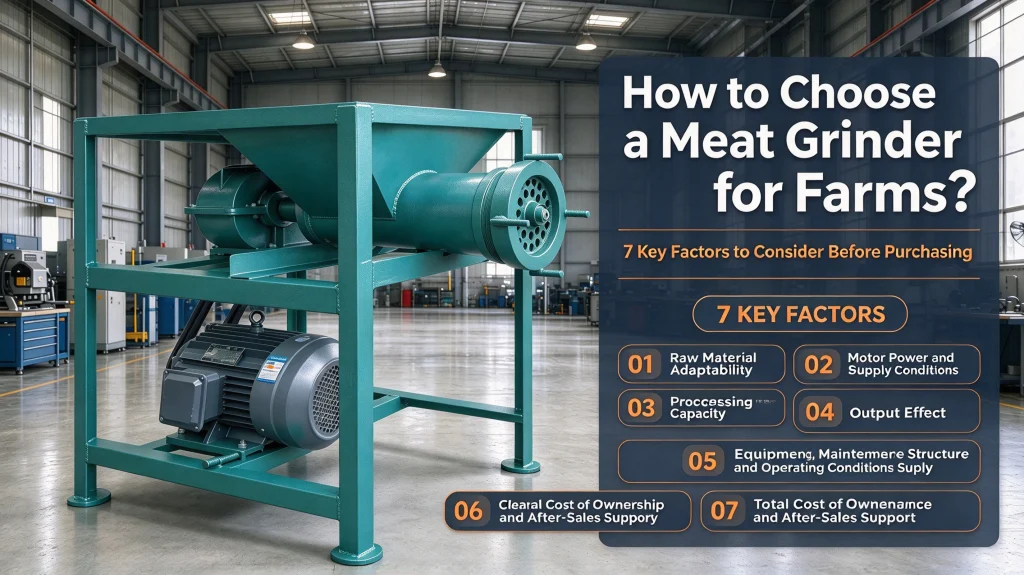
Before choosing a meat grinder, evaluate these seven factors:
- Raw material compatibility: Can the machine process your specific materials?
- Processing capacity: Does its actual throughput meet your daily requirements?
- Motor power and electricity supply: Are the electrical specifications suitable for your location and workload?
- Output requirements: Does the processed material meet your intended application requirements?
- Operating conditions and construction: Is the machine suitable for your expected operating schedule and working environment?
- Cleaning, maintenance, and spare parts: Can routine maintenance be performed efficiently?
- Total cost of ownership and technical support: What will the machine cost throughout its working life, and what assistance is available if problems occur?
The most important starting point is raw material compatibility. A machine should not be selected based on its advertised capacity alone if it cannot handle the materials used on the farm.
1. Check Raw Material Compatibility
The first question is whether the machine is designed for the material you intend to process.
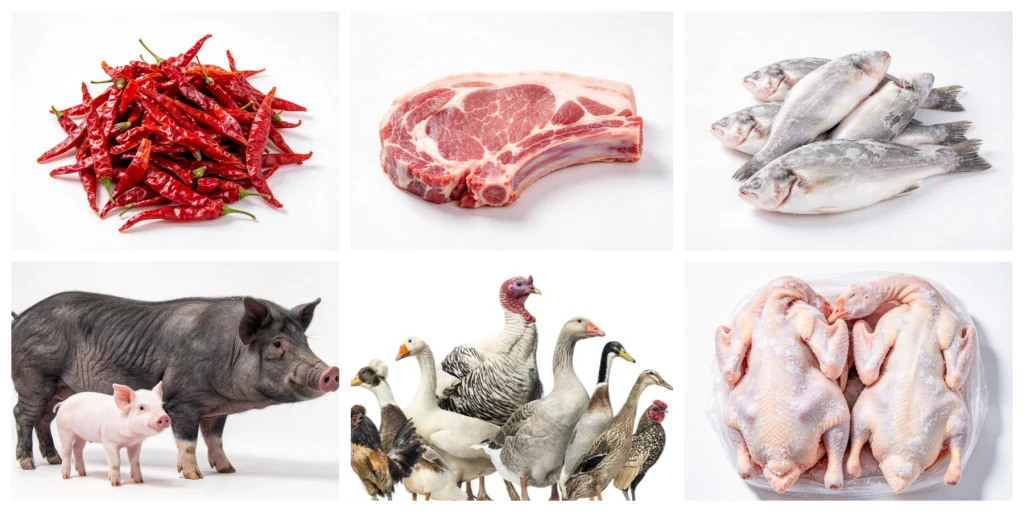
Depending on the farm’s operations, the material may include meat, fatty tissue, or other animal-derived materials. These materials can behave differently during processing and may require different machine configurations.
Before requesting a quotation, clarify the following:
- What material will be processed?
- Is it fresh, chilled, frozen, or partially thawed?
- What are the typical dimensions of the incoming material?
- Does the material contain large amounts of fat, connective tissue, or other components?
- Is any pre-cutting or preparation required?
- Will the machine process meat only, or must it also handle bones?
The last question is particularly important. A conventional meat grinder should not automatically be assumed to process bones. Bone crushing and meat grinding are different operations, and equipment suitability must be confirmed for the specific machine and material.
If bones or meat-and-bone mixtures are involved, ask the manufacturer to identify the appropriate equipment and demonstrate its performance using representative samples.
Practical recommendation: Provide the manufacturer with a clear description of your raw materials before comparing models. Where possible, request a processing test under documented conditions.
2. Match Processing Capacity to Daily Requirements
Processing capacity determines whether the equipment can keep up with the farm’s workload.
Manufacturers may specify capacity in kilograms per hour, but actual throughput can vary with material characteristics, feed size, machine configuration, and operating conditions.
For this reason, advertised capacity should be treated as a reference rather than a guaranteed result for every application.
Start by estimating your daily processing requirement.
For example, suppose a farm needs to process 300 kg of suitable material per day. If the planned processing period is three hours, the minimum average throughput required is:
300 kg ÷ 3 hours = 100 kg/h
This is a basic planning calculation, not a guarantee that a machine rated at 100 kg/h will meet the requirement. The farm should also account for loading, cleaning, routine interruptions, and variations in material.
When comparing equipment, ask:
- What is the rated capacity?
- Under what material and operating conditions was it measured?
- Is the figure based on continuous operation or a short test?
- How does material size affect throughput?
- What operating schedule is recommended?
Avoid choosing a machine solely because it has the highest advertised capacity. The objective is to select equipment that meets the actual workload without unnecessary investment.
3. Verify Motor Power and Electrical Compatibility
Motor power affects equipment selection, but a higher power rating does not automatically mean better performance for every application.
The appropriate motor depends on the machine design, material resistance, required throughput, and operating conditions.
Before purchasing, confirm the following electrical specifications:
| Specification | What to Check |
|---|---|
| Rated power | Whether the motor rating is appropriate for the intended workload |
| Voltage | Whether it matches the farm’s available supply |
| Frequency | Whether the equipment is compatible with the local electrical frequency |
| Phase | Whether single-phase or three-phase power is required |
| Starting requirements | Whether the electrical installation can support motor starting current |
| Protection | Whether suitable electrical protection is provided for the installation |
For international purchases, voltage, frequency, and phase deserve particular attention. Electrical specifications that are suitable for one country may not be suitable for another.
If the farm has limited electrical capacity, confirm the requirements with the equipment supplier and a qualified electrician before placing an order.
It is also useful to distinguish motor power from energy consumption. Motor power is a rated electrical or mechanical parameter, depending on how it is specified. Actual energy consumption depends on operating conditions and the time spent processing material.
4. Define the Required Output
The correct output depends on what happens to the processed material afterward.
Some operations require a relatively coarse result, while others need a more uniform or finer output. The appropriate result cannot be determined without understanding the intended application.
Before selecting a machine, clarify:
- What output texture or particle size is required?
- Does the downstream process have a specific size requirement?
- Is output consistency more important than maximum throughput?
- Does the machine use a particular cutting arrangement or screen configuration?
- Can the manufacturer demonstrate the required result using your material?
Where applicable, ask about available cutting components, screens, or other configuration options. Confirm which options are compatible with the selected model rather than assuming that every machine supports interchangeable parts.
A useful evaluation method is to inspect a representative sample of the processed material and record the conditions under which it was produced.
For an objective comparison, use similar raw materials and comparable test conditions when evaluating different machines.
This approach helps buyers distinguish between a machine that simply runs and one that produces an output suitable for the intended operation.
5. Evaluate Construction and Operating Conditions
A machine intended for occasional processing may have different requirements from equipment used regularly throughout the working day.
Before purchasing, consider the expected operating schedule and the environment in which the machine will be installed.
Important questions include:
- How many hours per day will the machine operate?
- Is it designed for the intended duty cycle?
- What materials are used in the parts that contact the processed material?
- Are the frame, drive components, and other major parts appropriate for the application?
- How much floor space is required?
- Is the machine easy to access for inspection and maintenance?
- What installation and ventilation requirements apply?
Material selection should be assessed according to the application. If the processed material is intended for animal feed or another regulated use, contact-material suitability and applicable local requirements should be confirmed rather than assumed.
The working environment also matters. Dust, moisture, temperature, cleaning methods, and available space can affect installation and maintenance requirements.
Ask the manufacturer for the equipment dimensions, installation instructions, operating limitations, and any relevant material specifications.
6. Consider Cleaning, Maintenance, and Spare Parts
Maintenance affects equipment availability and long-term operating costs.
A machine that is difficult to inspect, clean, or service may require more labor and longer interruptions than expected.
Before purchasing, find out which parts require routine attention and how maintenance is performed.
Typical questions include:
- Which components are considered wear parts?
- How frequently should the machine be inspected?
- What cleaning procedure is recommended?
- Which tools are required for routine maintenance?
- How are cutting components or other serviceable parts replaced?
- Are spare parts available for the selected model?
- Can replacement parts be identified from a parts list or diagram?
The answers depend on the machine design, material processed, and operating conditions. Maintenance intervals should follow the manufacturer’s instructions rather than a general schedule applied to every machine.
Spare-part availability is especially relevant when the farm depends on the equipment for regular operations. Buyers should confirm the availability, identification, ordering process, and estimated delivery arrangements for important replacement components.
Cleaning procedures also require attention. Follow the manufacturer’s instructions for isolation of electrical power, disassembly, cleaning agents, drying, and reassembly. Guards and other safety devices should remain in place during normal operation.
A clear maintenance plan can help reduce avoidable downtime and make operating costs easier to estimate.
7. Compare Total Cost of Ownership and Technical Support
The purchase price is only one part of the cost of owning a meat grinder.
A more complete comparison includes the initial investment, installation, electricity, labor, maintenance, spare parts, and the financial impact of downtime.
A simple framework is:
Total cost of ownership = purchase cost + installation cost + operating cost + maintenance and spare-part costs + downtime-related costs
The calculation period should be the same when comparing different machines. For example, a three-year estimate should use the expected costs over three years for each option.
Where reliable data are available, buyers can compare the cost per kilogram processed:
Cost per kilogram = total processing cost ÷ total kilograms processed
This measure is useful only when the machines are evaluated under comparable conditions and the cost categories are defined consistently.
Technical support is another consideration. Before purchasing, clarify:
- What technical documents are supplied?
- Is remote troubleshooting available?
- What warranty terms apply?
- How are replacement parts ordered?
- What information is required when reporting a fault?
- Are installation guidance and operating instructions available in a language the operators understand?
Support arrangements differ between manufacturers and purchasing agreements. Buyers should verify the actual terms in writing rather than relying on general statements about after-sales service.
The lowest purchase price does not necessarily represent the lowest long-term cost. Equally, a more expensive machine is not automatically a better investment. The decision should be based on documented suitability, operating requirements, and realistic cost estimates.
A Practical Checklist for Comparing Meat Grinders
The following checklist can be used when requesting quotations from different suppliers.
| Evaluation Item | Information to Request |
|---|---|
| Intended material | Approved material types and limitations |
| Preparation requirements | Maximum incoming dimensions and any pre-processing requirements |
| Rated capacity | Capacity figure and the conditions under which it was measured |
| Output | Available configurations and demonstrated processing results |
| Motor | Rated power and relevant electrical specifications |
| Installation | Dimensions, floor space, and installation requirements |
| Operating schedule | Recommended duty cycle and operating limitations |
| Maintenance | Inspection, cleaning, and replacement procedures |
| Spare parts | Parts list, availability, and ordering arrangements |
| Warranty | Written warranty terms and exclusions |
| Technical support | Available support channels and scope |
| Total cost | Purchase, installation, operating, and maintenance estimates |
For a fair comparison, request the same categories of information from each supplier. This makes it easier to identify missing specifications and compare machines on a consistent basis.
Frequently Asked Questions
What is the most important factor when choosing a meat grinder for a livestock farm?
Raw material compatibility is the most important starting point. The machine must be suitable for the material being processed before capacity, power, or price can be meaningfully compared.
How do I calculate the required meat grinder capacity?
Divide the daily processing requirement by the planned processing hours to estimate the minimum average throughput. Then account for loading, cleaning, interruptions, and material variations. Confirm the final selection through representative processing tests where possible.
Is a higher motor power rating always better?
No. Motor power should be considered alongside machine design, raw material characteristics, throughput, and operating conditions. A higher rating alone does not establish that a machine is more suitable.
Can a conventional meat grinder process bones?
Not necessarily. A conventional meat grinder should not be assumed to handle bones unless the manufacturer explicitly confirms that the specific model is designed and rated for the intended material. Bone crushing and meat grinding may require different equipment.
What should I ask a supplier before buying a meat grinder?
Confirm material compatibility, rated capacity and test conditions, output requirements, electrical specifications, operating limitations, maintenance procedures, spare-part availability, warranty terms, and technical support arrangements.
How can I compare the long-term costs of different machines?
Use the same evaluation period and include purchase, installation, energy, labor, maintenance, replacement parts, and relevant downtime costs. Where possible, compare the cost per kilogram processed under comparable operating conditions.
Should I choose a machine based on price or capacity?
Neither should be considered in isolation. First confirm that the equipment can process the intended material and produce the required output. Then compare capacity, operating requirements, maintenance, support, and total ownership cost.
Conclusion
Choosing a meat grinder for a livestock farm requires a clear understanding of the material being processed, the required output, and the farm’s daily workload.
The most reliable approach is to define the application first, verify capacity and electrical compatibility, evaluate maintenance requirements, and compare the full cost of ownership. Written specifications and representative processing tests provide a stronger basis for selection than price or advertised performance alone.
Before requesting a quotation, prepare a short description of your raw materials, daily processing volume, required output, available power supply, and expected operating schedule. Providing this information helps equipment suppliers determine whether a particular machine is suitable and what additional checks may be necessary.